
- Practical Management System Training for SMEs
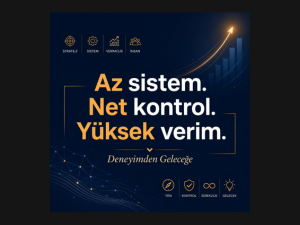
Practical Management System Training for SMEs
Take control of your business without building complex structures
In many SMEs, daily operations move forward thanks to hard work, experience, and close personal follow-up. However, as the business grows, customer demands increase, decision points multiply, responsibilities may become unclear, and recurring problems may start to appear.
This training is designed to introduce a simple, practical, and measurable management system approach that can be adapted to the daily operations of SMEs.
The aim is not to create heavy procedures or documentation that becomes a burden for the business. Instead, the focus is on helping businesses become more manageable through clear goals, processes, responsibilities, measurement, and decision mechanisms.
Core approach:
Minimal system. Clear control. Higher efficiency.
Purpose of the Training
The purpose of this training is to help SMEs make their current way of working more visible, traceable, and improvable.
By the end of the training, participants will learn how to:
define clear business goals,
simplify critical processes,
clarify task, decision, and follow-up responsibilities,
select key metrics that reflect the pulse of the business,
establish a regular follow-up and improvement culture.
The core question throughout the training is:
What can we manage more systematically in our business starting tomorrow?
Who Should Attend?
This training is especially suitable for:
SME owners and partners
Decision-makers who want to manage their business in a more systematic, measurable, and sustainable way.
Family business managers
Managers who want business operations to rely less on personal follow-up and more on processes, responsibilities, and measurement.
General managers and business managers
Executives who want to make daily operations more visible and controllable.
Production, sales, operations, and service managers
Team leaders who want to simplify customer requests, production, delivery, quality, and follow-up processes.
Businesses in the institutionalization process
Companies that want to build a practical management backbone before starting ISO, quality, process management, or digital transformation initiatives.
Duration and Format
Duration: 6 hours
Format: Online or face-to-face
Method: Presentation, examples, mini exercises, worksheets, and group discussions
Participant Profile: SME owners, managers, team leaders, and decision-makers
The training is designed with a strong practical focus rather than purely theoretical knowledge transfer. Participants work on goals, processes, responsibilities, and metrics based on their own business context.
Learning Outcomes
By the end of the training, participants will be able to:
interpret the concept of a management system for SMEs in a simple and practical way.
evaluate recurring business problems from a system perspective.
turn general intentions into SMART goals.
define customer request, sales, production, or service processes through simple workflows.
clarify roles and responsibilities by asking: “Who does it, who decides, and who follows up?”
identify key metrics to monitor business performance.
establish a practical structure for weekly follow-up, decision-making, and improvement.
create an initial 30–60–90 day management system roadmap for their own business.
6-Hour Training Topics
1. Why Do SMEs Need a Management System?
Duration: 45 minutes
This section focuses on the management challenges that emerge as SMEs grow.
Subtopics:
How business operations often rely on personal follow-up in SMEs
Increasing complexity during business growth
Recurring problems and hidden costs
What a management system is — and what it is not
A work-oriented system approach instead of a documentation-oriented one
MVMS approach: a minimal but functioning system
Key message:
A management system is the management backbone that makes daily business operations visible, traceable, and improvable.
2. Goal Management: What Do We Want to Achieve?
Duration: 60 minutes
This section focuses on turning business goals from general statements into measurable and traceable targets.
Subtopics:
The difference between goals, intentions, and wishes
The SMART goal approach
Specific, measurable, achievable, relevant, and time-bound goals
Linking SME goals with sales, customers, production, and efficiency
Turning goals into trackable indicators
Exercise:
Participants create one SMART goal for their own business.
Example:
Instead of saying:
“We want to increase sales.”
A SMART version would be:
“To increase the number of regular monthly customers from 120 to 150 within the next 6 months.”
3. Process Management: How Does Work Flow?
Duration: 75 minutes
This section focuses on defining critical business workflows in a simple way.
Subtopics:
What is a process?
Key SME processes: customer requests, sales, production, delivery, collection
Connecting work to workflows rather than individuals
Customer request process example
Making delays, handover gaps, and rework visible
Creating a simple process map
Exercise:
Participants map a simple workflow from customer request to closure.
Key question:
When a customer request arrives, who receives it, where is it recorded, who evaluates it, and who follows it up?
4. Roles, Responsibilities, and Decision Mechanisms
Duration: 60 minutes
This section clarifies who owns the work, who makes decisions, and how follow-up is managed.
Subtopics:
The difference between task, responsibility, and authority
“Who does it?”
“Who decides?”
“Who follows up?”
Identifying decision points
Operational impact of unclear responsibilities
Simple responsibility and follow-up matrix
Exercise:
Participants define task, decision, and follow-up responsibilities for a selected process.
Key message:
If a task has no clear owner, it may look like everyone’s job, but in practice it often becomes no one’s responsibility.
5. Measurement and Metrics: Seeing the Pulse of the Business
Duration: 75 minutes
This section focuses on how to select simple and meaningful metrics to monitor business performance.
Subtopics:
What is a metric?
The difference between a metric and a KPI
Measuring the right indicators, not everything
Key metric examples for SMEs
First response time
On-time delivery rate
Quote-to-order conversion rate
Error / scrap rate
Customer satisfaction
Weekly tracking table and simple dashboard approach
Exercise:
Participants select a management question, metric, target value, and first action for a recurring problem in their business.
Key message:
A good metric makes a problem visible and supports better management decisions.
6. Follow-up, Improvement, and 30–60–90 Day Roadmap
Duration: 45 minutes
This final section helps participants create a simple implementation plan that they can adapt to their own business.
Subtopics:
How to structure a weekly management meeting
Decision and action tracking
Learning from recurring problems
Small improvement cycle
30-day analysis period
60-day system-building period
90-day measurement and improvement period
Exercise:
Participants define their first three actions for their own business.
Key message:
A management system does not have to start as a large and complex project. It starts with small but regular steps.
- Contact
Our expertise in our relationships and in our training is our ilk. If you get in touch with us, we can decide together how we can help you and how we can contribute. You can contact us for your immediate needs or your long-term goals.
Address
Ankara / TURKEY